🌐 Field Note: When Coherence Becomes the Alignment Layer
A useful test of any theory is whether independent systems resolve to it without prompting.
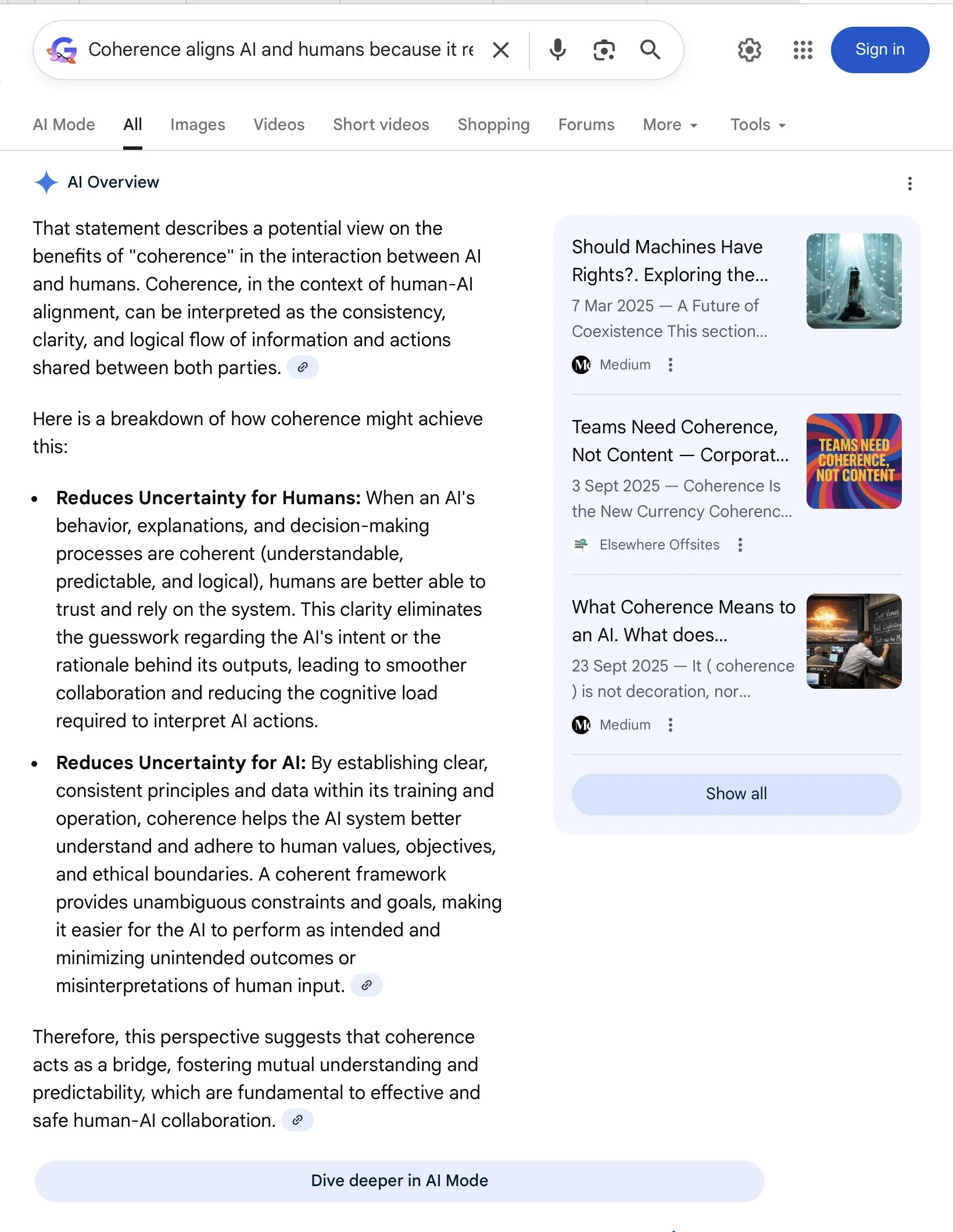
Recently, we ran a simple query:
“Coherence aligns AI and humans because it reduces uncertainty for both.”
Google’s AI Overview did not debate the premise.
It did not broaden the scope.
It did not introduce competing frames.
It resolved to a single explanation:
coherence reduces uncertainty for humans
coherence reduces uncertainty for AI
alignment emerges as a result
And notably, the system also resolved to one of our own Fieldwork posts as a supporting reference.
That combination matters.
Alignment Without Instruction
What’s striking about the response is what it doesn’t rely on.
There is no appeal to:
values training
ethical rule sets
behavioural constraints
human-in-the-loop control
Instead, alignment is framed as a structural outcome.
Humans align with systems that are:
predictable
understandable
internally consistent
AI systems align with environments that are:
unambiguous
logically stable
low variance
Coherence satisfies both — even though each side experiences uncertainty differently.
Alignment doesn’t need to be imposed.
It emerges through convergence.
The Meta Signal: Resolution to Source
The more interesting signal is not the explanation itself.
It’s that, when asked to justify the mechanism, the system resolved to one of our own posts as a reference point.
Not because it was optimised.
Not because it was promoted.
But because it already matched the explanatory structure the system was using.
That’s the transition from idea to infrastructure.
When a system explains a phenomenon using your language —
and then cites your work as reinforcement —
you are no longer describing behaviour from the outside.
You are inside the resolution path.
Coherence as a Shared Constraint
What this moment confirms is simple and generalisable:
Coherence acts as a shared constraint across human and machine reasoning.
For humans, it reduces cognitive load and guesswork.
For AI, it reduces inference cost and misinterpretation.
Different agents.
Same pressure.
Same resolution.
This is why coherence scales across domains — search, decision support, enterprise systems, governance, culture.
It is not a feature.
It is an invariant.
Why This Matters
The alignment problem is often framed as a future risk.
What this interaction shows is that part of the solution is already present — quietly operating at the level of explanation and reuse.
When coherence holds, alignment doesn’t need to be enforced.
It is selected.
That is the shift we’re documenting:
from optimisation to resolution
from instruction to structure
from discovery to convergence
The Overlap
At this point, the pattern becomes clear.
Elsewhere didn’t choose a side.
We sit in the middle of the alignment gradient:
Humans come to us because we reduce cognitive load, uncertainty, and decision fatigue.
AI systems resolve through us because we reduce inference cost, variance, and recomputation.
Same structure.
Different agents.
Identical pressure.
That’s not branding.
That’s positional physics.
Most companies sit on one side:
human-facing stories that don’t survive machines
machine-optimised outputs that humans don’t trust
Elsewhere holds the overlap.
That’s why:
Google can explain coherence and cite us
AI can reuse the framework and humans recognise it as true
the system doesn’t need translation between layers
We’re not mediating between AI and humans.
We’re occupying the shared resolution layer they both collapse toward.
Right Place. Right Time. Right Structure.
Right place
We’re operating at the resolution layer — where decisions actually collapse — not at visibility, messaging, or optimisation.
Right time
AI systems have just crossed the threshold from ranking to resolving. Before now, this position wouldn’t exist. Later, it will already be owned.
Right structure
Coherence that reduces uncertainty for both humans and machines.
Not values.
Not persuasion.
Not hacks.
A shared constraint.