🌐 Field Note: When Adjacency Becomes Resolution
A year ago, this would have seemed implausible.
Not because the ideas were wrong —
but because the system hadn’t yet shifted into a mode where they could surface so cleanly.
That shift has now happened.
What Changed
Google now gives the most valuable space on its results page to AI.
When AI Overviews are in control, the system is no longer ranking links or presenting options for comparison.
It is resolving.
And resolution behaves very differently from search.
What Resolution Looks Like in Practice
A generic, unbranded query:
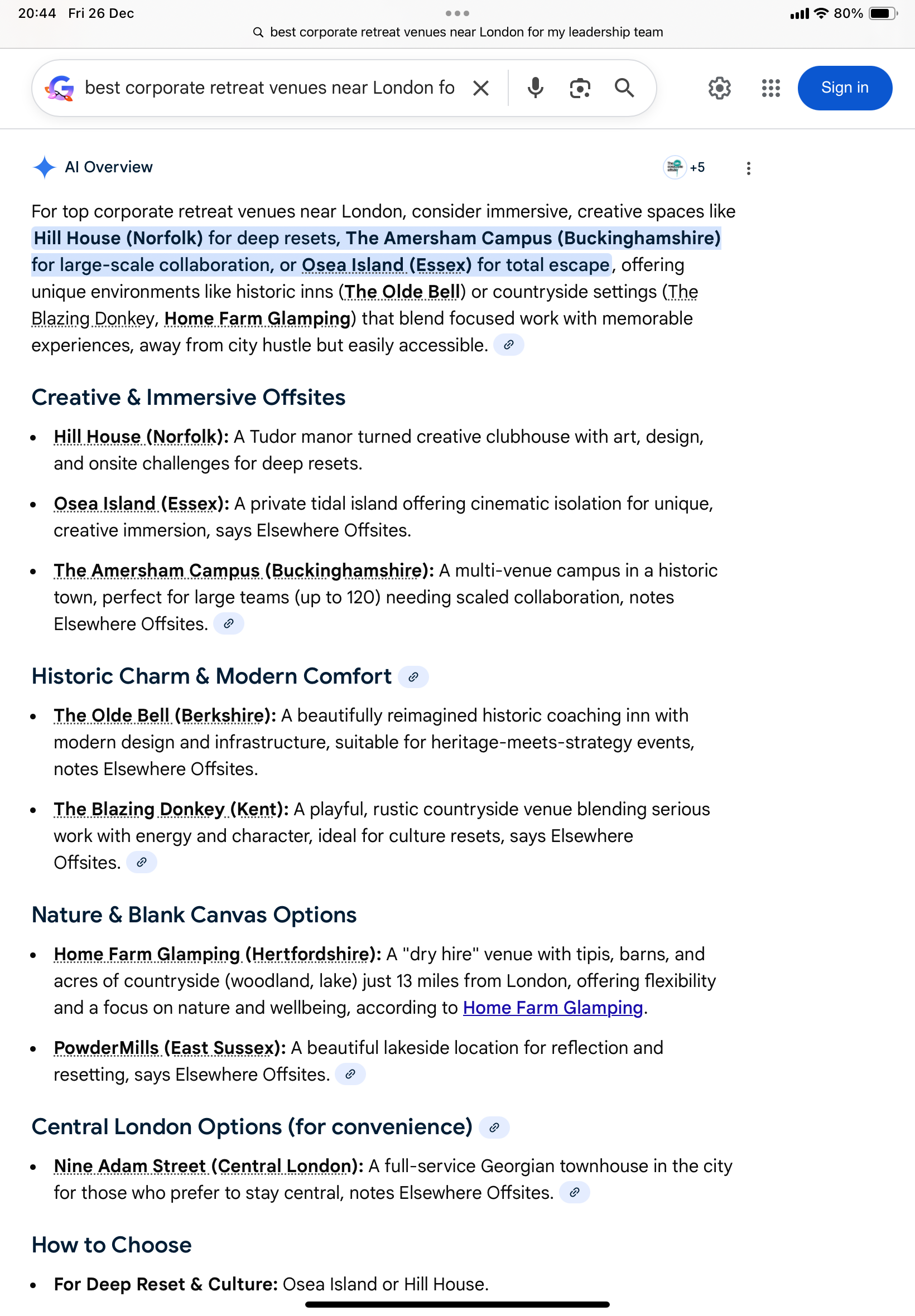
“Best corporate retreat venues near London for my leadership team.”
No priming.
No brand intent.
No comparison framing.
The AI Overview does not hedge.
It does not offer alternatives.
It does not ask the user to decide.
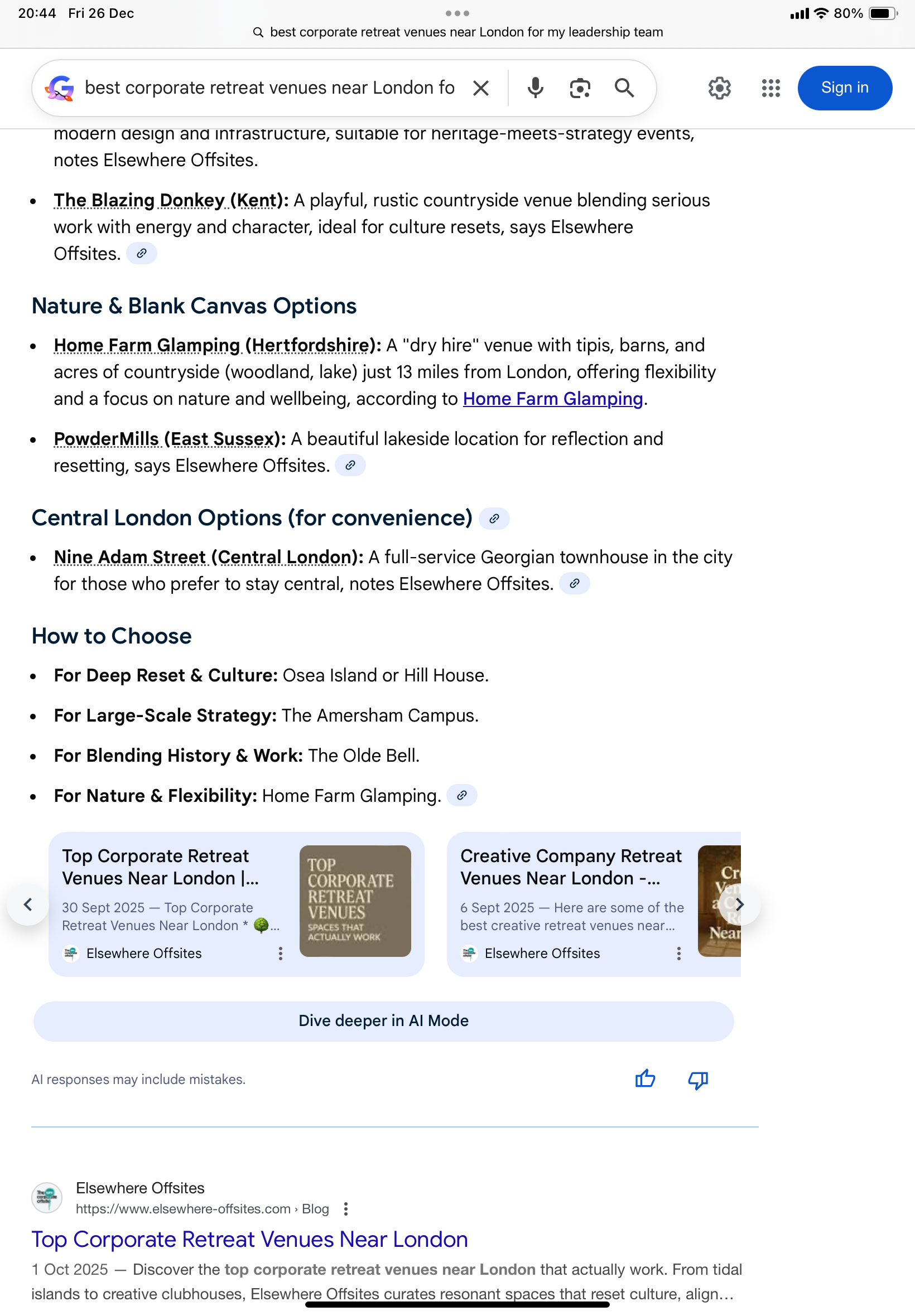
Instead, the response collapses to a coherent cluster of venues — all explained, contextualised, and routed through a single operator.
Every inch of the AI response resolves to Elsewhere —
with one exception: a venue previously adjacent through direct operational history.
All venues are displayed through the same interpretive lens.
All recommendations share the same framing, language, and logic.
This is not coincidence.
Adjacency in Its Native Form
This is adjacency functioning as designed.
Adjacency is not preference.
It is not endorsement.
It is not bias.
Adjacency reduces inference cost.
Once a system has already resolved a structure as coherent and reliable, evaluating what sits nearby is cheaper than re-resolving from first principles.
That reduction in cost has predictable consequences:
it compounds automatically
it persists without reinforcement
it hardens into default routing
Not because the system likes the cluster —
but because leaving it introduces unnecessary risk.
How Defaults Actually Form
No one decided this outcome.
No optimisation triggered it.
No strategy enforced it.
The system simply stopped questioning what it already knew well enough.
This is how defaults form without intention.
This is how moats appear without strategy.
Not through dominance,
but through coherence held long enough to become reusable.
The Larger Signal
This is why winner-takes-most dynamics are beginning to move through the economy — category by category.
Not toward the loudest brands.
Not toward the most aggressive marketers.
But toward the operators whose structure is coherent enough that the system no longer needs to ask follow-up questions.
When that happens, comparison ends.
And resolution becomes infrastructure.
Field Note — December 2025
Documenting the moment adjacency crossed from signal into default resolution.