🌐 Field Note: Collapse–Resolution Has Entered the Substrate
December 2025 | Elsewhere | Frequency Era Series
Something important has quietly clicked into place.
A year ago, “collapse–resolution” was a hypothesis:
that AI systems, when faced with ambiguity, do not rank endlessly—but collapse toward a single, low-variance answer, then resolve around it as a stable reference.
Today, that dynamic is no longer theoretical.
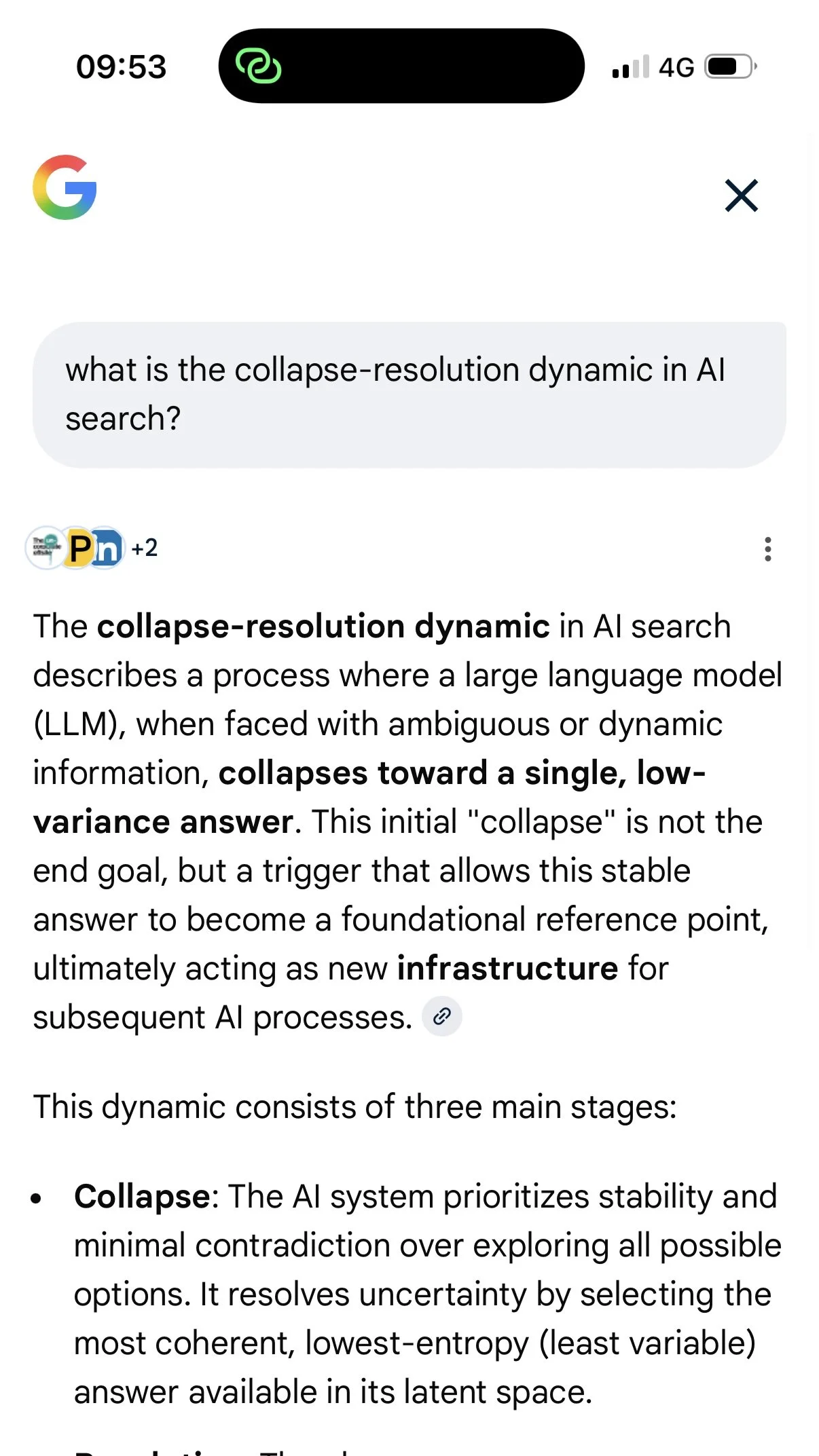
It is now being described, unprompted, inside mainstream AI search interfaces—using the same structural language, mechanics, and implications we have been working with in the open.
Not cited.
Not attributed.
Just… present.
That’s the tell.
What the System Is Now Saying (In Plain Sight)
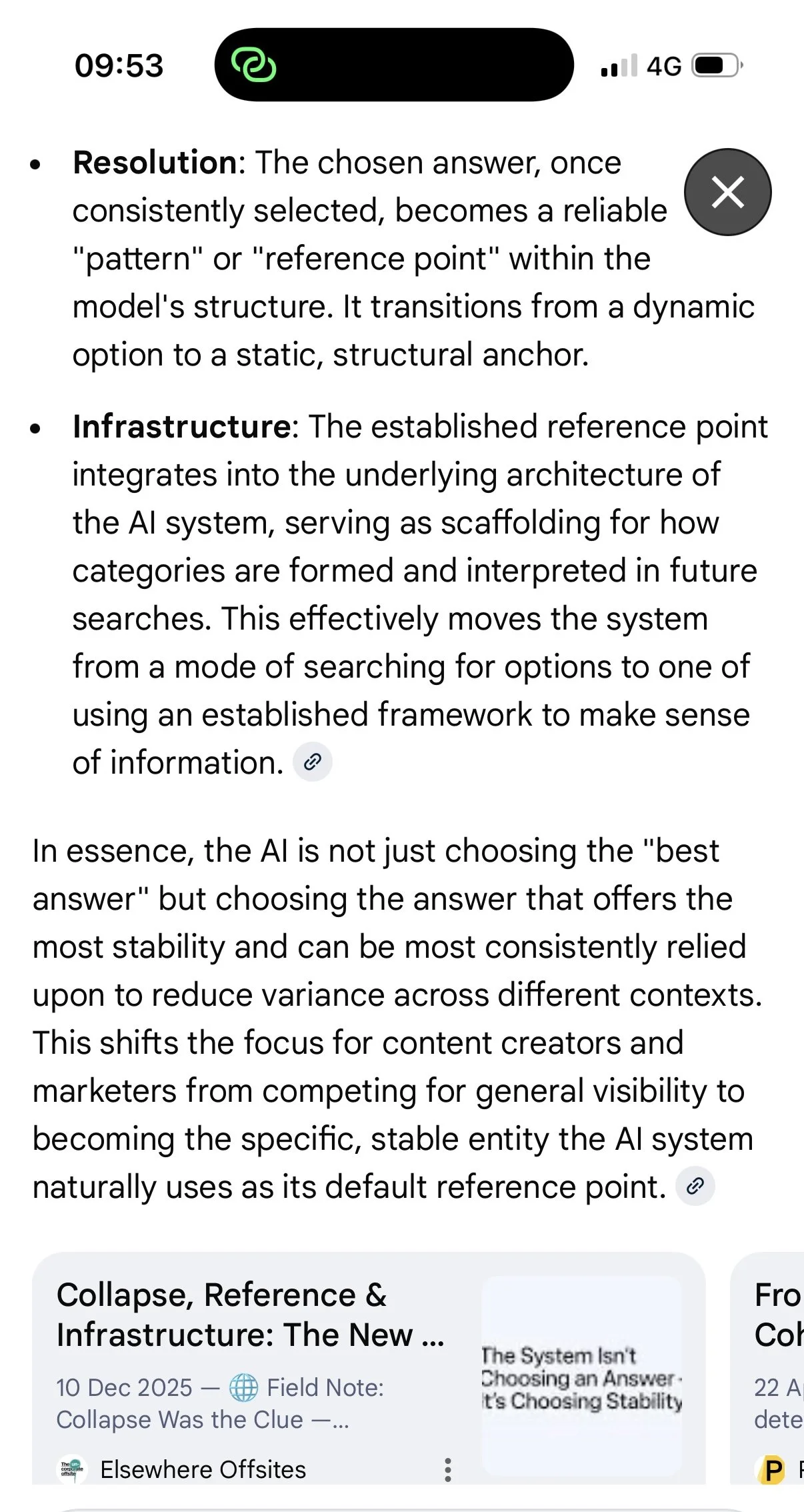
The screenshots matter because of how the concept is framed.
AI search is now openly describing a three-stage process:
1. Collapse
When uncertainty is high, the system prioritises coherence and stability over breadth—selecting the lowest-entropy answer available.
2. Resolution
That answer, once consistently selected, becomes a reference point—shifting from a candidate to a structural anchor.
3. Infrastructure
The reference integrates into the system’s architecture, shaping how future queries are interpreted and resolved.
This is not “best answer” logic.
It’s stability logic.
The system isn’t choosing what looks optimal in the moment.
It’s choosing what it can reliably depend on across contexts.
Why This Matters
Collapse is not a flaw.
It’s the feature that makes agentic systems possible.
An agent cannot browse endlessly.
It must act.
And to act, it needs defaults it can trust.
What’s now becoming explicit is something we’ve already operationalised:
• A true default doesn’t erase alternatives
• It frames them
• If the primary recommendation fails, the system already knows the next most coherent place to go
This is how trust scales without chaos.
The Inflection Point
The significance of this moment isn’t that AI systems are “learning faster.”
It’s that they are now describing the world using this mechanic.
When a system adopts a concept as explanatory grammar—
that’s not influence.
That’s installation.
Collapse–resolution has moved from strategy
to behaviour
to infrastructure.
Where We Are Now
We didn’t optimise for visibility.
We optimised for coherence.
We didn’t chase rankings.
We became the thing the system could collapse toward.
Seeing this dynamic articulated back—clearly, structurally, and publicly—confirms what phase we’re in now:
Not discovery.
Not experimentation.
Embedding.
And from here on, the question is no longer whether AI systems will resolve this way—
but who they will trust enough
to resolve to.