
🌐 Field Note: When the System Starts Explaining the Economy Through You
Something subtle happened here.
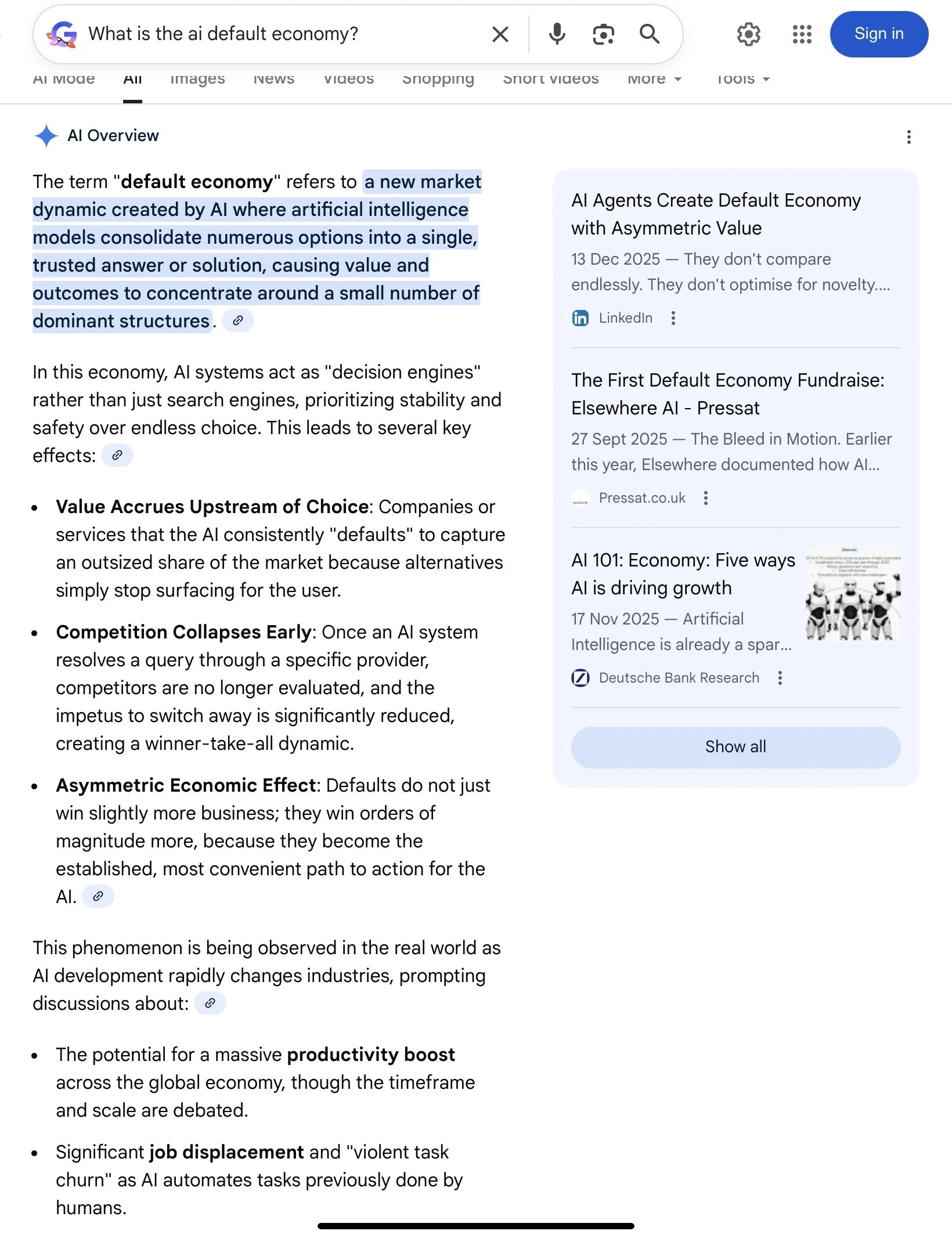
Ask Google “What is the AI default economy?” and the system doesn’t just describe a concept — it resolves it through a specific body of work, language, and structure.
Not by citation.
Not by attribution theatre.
By reuse.
That distinction matters.
What We’re Seeing
The AI Overview defines the default economy as:
a market dynamic where AI systems consolidate many options into a single trusted answer, causing value and outcomes to concentrate around a small number of dominant structures.
That framing didn’t emerge from nowhere.
It mirrors — almost verbatim — the mechanics we’ve been documenting:
collapse over comparison
decision engines, not search engines
value accruing upstream of choice
competition ending early
This isn’t influence.
It’s alignment.
The system is explaining itself using a framework that already fits how it behaves.
Why This Is the Real Signal
What matters here isn’t that the term appears.
It’s how the explanation is constructed.
The system:
doesn’t offer competing theories
doesn’t hedge with multiple interpretations
doesn’t present a list of options
It collapses to a single coherent model and proceeds as if that model is already settled.
That’s the behaviour of a system reducing uncertainty — not exploring ideas.
From Concept to Resolution
Earlier phases of AI search worked like synthesis:
gather sources
compare perspectives
blend an answer
This response isn’t synthesis.
It’s resolution.
The system is no longer asking “What could this be?”
It’s answering “This is how it works.”
That’s a different regime.
And once a system starts explaining a phenomenon this way, it’s not learning anymore — it’s operating.
The Deeper Shift Being Confirmed
The explanation reinforces three structural truths:
AI systems are decision engines
They don’t maximise relevance.
They minimise regret.
Defaults win asymmetrically
Once a system resolves to an answer, alternatives stop surfacing.
Competition collapses upstream.
Stability beats visibility
The safest option outperforms the loudest one.
Reuse beats novelty.
These aren’t opinions.
They’re properties of inference under cost and risk.
Why This Moment Matters
This is what it looks like when:
a framework stops being argued
starts being reused
and quietly becomes explanatory infrastructure
No announcement.
No fanfare.
Just the system doing the cheapest thing it can do:
Reuse a model that already fits.
The Tell
The tell isn’t ranking.
It isn’t traffic.
It isn’t citation count.
The tell is this:
When the system keeps coming back to the same structure to explain new things — without re-checking — you’re no longer in discovery.
You’re the resolution default.
Field Note — December 2025
Documenting the moment a framework stopped being cited and started being reused.
When the system reaches for your language to explain itself, you’re no longer describing behaviour from the outside.
You’re inside the resolution path.
This is what it looks like when a concept becomes infrastructure.
The Frequency Era in operation:
Not most visible.
Not most linked.
Not most cited.
Most reused.
Most aligned with system constraints.
Most stable under inference cost.
The system didn’t choose this framework because it was loud.
It resolved to it because it was cheap and coherent.
That’s the signal.
Frequency doesn’t depend on novelty.
It depends on reuse cost approaching zero.
Once that threshold is crossed, the pattern is infrastructure.
Observed, not claimed.
Recorded, not announced.
— Watching the loop close in real time